In recent years, the AI-driven software development ecosystem has lived in a “bubble of abundance.” Large Language Model (LLM) providers like OpenAI and Anthropic offered flat-rate, “all-you-can-eat” subscription models and subsidized inference at a loss to capture market share. Building software agents simply meant chaining prompts and making unlimited calls to cloud APIs without worrying about token consumption.
This golden era is coming to an end.
We are now facing an inevitable transition: the end of subsidized inference. Volume-based pricing and the progressive elimination of flat-rate corporate tiers are forcing developers and architects to completely rethink how they build AI-powered systems.
1. The Problem: The Hidden Cost of Inefficient Agents
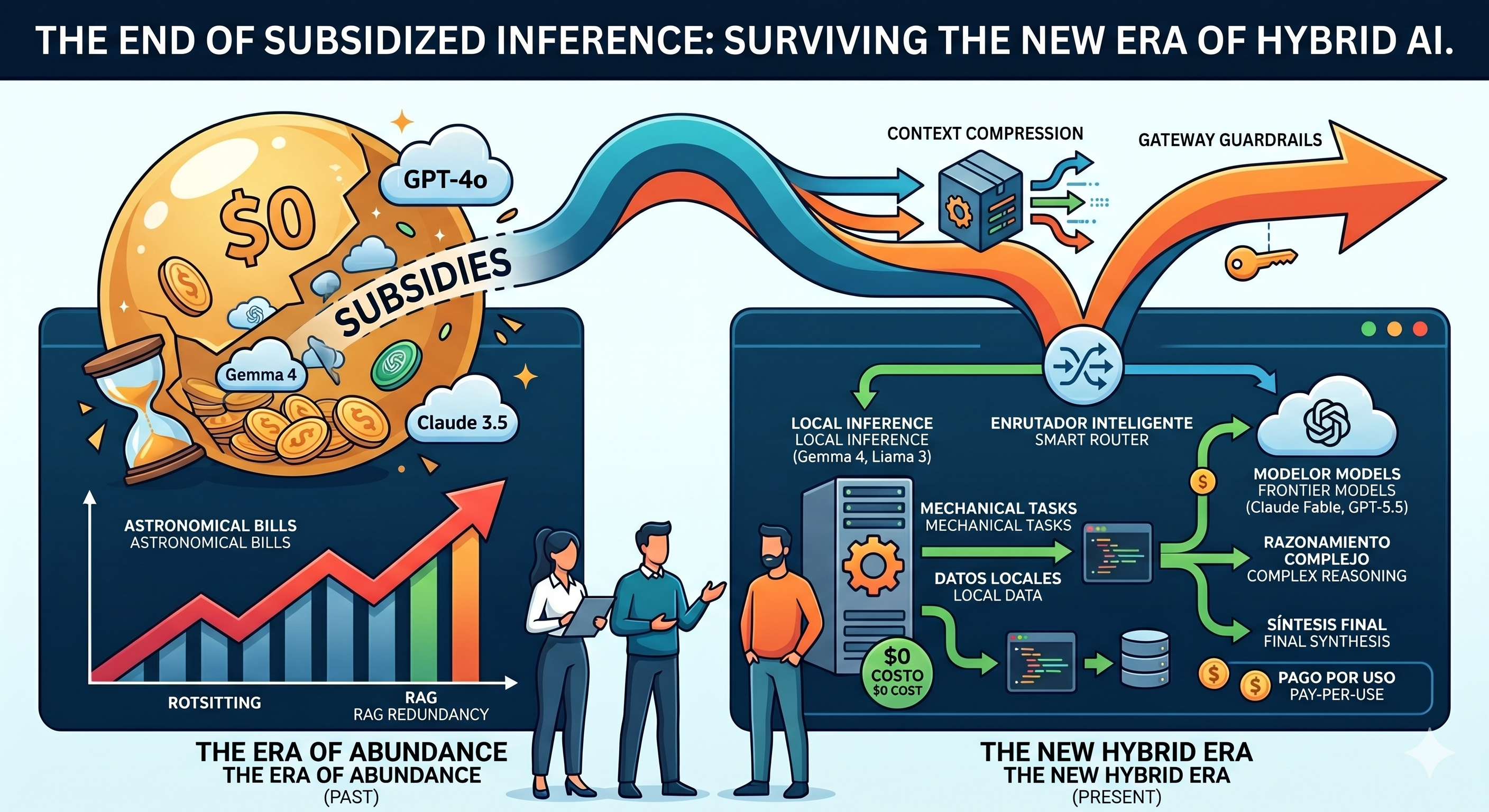
The debate has exploded on Hacker News and software architecture forums: developers who built autonomous agent systems relying exclusively on commercial APIs (such as GPT-4o or Claude 3.5 Sonnet) have been hit with astronomical bills and questionable returns on investment (ROI).
This inefficiency is primarily driven by two factors:
- Redundancy in RAG (Retrieval-Augmented Generation): Sending full documents and massive context windows repeatedly through commercial APIs for every minor user interaction.
- The “Botsitting” Phenomenon: Developers spending more time supervising, correcting, and guiding autonomous agents that generate low-quality code than writing code themselves. Every failed attempt by the agent translates to multiple commercial API calls that consume tokens at premium prices.
Relying blindly on cloud inference for every elementary task—from basic input classification to JSON format validation—is no longer a financially viable model.
2. The New Paradigm: Hybrid Inference and Context Compression
To mitigate this issue, AI system architecture is rapidly shifting toward a hybrid model. The goal is not to stop using the most powerful frontier models, but rather to be smart about when and how they are invoked.
The following three major trends and technical measures are defining this new era of efficiency:
A. Smart Context Compression (Token Middleware)
Context optimization is the first line of defense. Emerging open-source tools like headroom (a prompt-compression proxy) demonstrate that it is possible to reduce token consumption by 60% to 95% without compromising response quality.
- How it works: These proxies analyze agent logs, previous responses, and RAG-retrieved chunks, removing redundancy and compressing the information before it is sent to the paid API.
- Key Takeaway: Concepts > Code. Before sending a 10,000-token prompt to a premium model, the context must be structured and reduced within the software’s transport layer.
B. Hybrid Local Inference and Data Sovereignty
The maturity of open-source, medium-sized models (such as the Gemma 4 or Llama 3 series) allows running initial processing steps locally or in a self-hosted environment.
- Autonomous Local Workspaces: Platforms like odysseus and OpenClaw enable isolated workspaces that execute locally.
- Routing Strategy:
- Mechanical tasks (classification, entity extraction, syntax validation, initial testing): These are delegated to lightweight local models running at zero cost on self-hosted hardware.
- Complex reasoning (final synthesis, architectural decisions, complex conflict resolution): These are routed in a controlled manner to commercial frontier APIs in the cloud (such as Claude Fable or GPT-5.5).
C. Hierarchical Security Routing and Fallbacks (Gateway Guardrails)
Inspired by recent market shifts (where dual models automatically redirect sensitive queries to legacy or specific versions), modern architecture must implement Gateway Guardrails.
Instead of having applications interact directly with a single LLM, a smart router is implemented. If a user query requires strict safety validation or falls under a specialized domain, the gateway internally reroutes the request to a more optimal model or one with specific filters, ensuring predictability and cost control.
3. Industry Measures and Best Practices
To adapt workflows to this new reality, organizations and development teams are implementing a series of operational measures and best practices:
- Implementation of Compression Proxies: Token and context optimization proxies are integrated into large-scale RAG pipelines to reduce operational costs immediately.
- Adoption of Local TDD for Agents: Before allowing an autonomous AI agent to push code to repositories or consume cloud resources by iterating, local test suites (TDD) are configured so the agent can validate its own solution locally and at no cost.
- Standardization of Hybrid Routing: Architects reserve premium commercial frontier models exclusively to act as the “thinking layer” for complex reasoning and synthesis, while delegating orchestration and mechanical tasks to lightweight local models.
The end of subsidized inference is not bad news; it is a call to maturity for software engineering. It forces developers to move away from lazy design patterns based on “throwing tokens at the problem” and start building software architectures that are efficient, scalable, and truly robust.