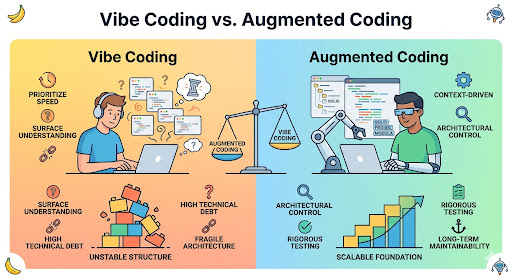
n recent months, a concept has dominated discussions in specialized forums and engineering teams: “vibe coding.” Coined in early 2025 by Andrej Karpathy, the term describes a development modality where programmers use AI assistants (like Cursor, Windsurf, or Claude Code) to generate entire applications interacting purely in natural language. The initial promise was technical liberation: dictate the expected behavior, iterate on the result, and deploy without needing to read or understand every line of the underlying code.
For rapid prototypes or isolated projects, the productivity boost is undeniable. However, as the initial hype settles and this practice clashes with real production environments, the global community is arriving at a critical consensus: total automation lacks architectural context. Delegating engineering to “vibes” doesn’t eliminate technical debt; it multiplies it.
The Data Speaks: The Hidden Cost in Code Quality
The limit of vibe coding is not typing speed, but scale, maintenance, and system understanding. Recent investigations have quantified the impact of delegating business logic purely to generative models:
- Surge in Technical Debt: A comprehensive analysis by GitClear on AI-assisted codebases revealed a significant decline in refactoring activities and an alarming increase in code duplication. “Code churn” (code that is rewritten or deleted shortly after creation) nearly doubled, translating into an estimated increase of 30% to 41% in technical debt in the long term.
- Bottlenecks in Reviews: Far from streamlining the entire Software Development Life Cycle (SDLC), AI-generated code shifts the effort to the validation stages. Data from CodeRabbit indicates that reviewers spend 91% more time evaluating Pull Requests generated by artificial intelligence. The sheer volume produces review fatigue, leading to automatic approvals (“rubber-stamping”) that let vulnerabilities slip through.
- Architectural Blindness: Tech consultancies like Thoughtworks have warned that language models lack “institutional memory.” A model optimizes the solution so that the current functionality operates, without considering that a component overloaded with dependencies will be unmanageable in three months.
The Wall of Enterprise Complexity
AI-generated code works excellently in a vacuum. But when development moves from an isolated script to real orchestration problems, the abstraction collapses.
Implementing modern architectures—such as a multi-agent auditing system using LangGraph and MCP (Model Context Protocol) servers to interact with legacy databases—requires strict control of permissions and information routing. Critical infrastructure tasks, like migrating Kubernetes pods between different node pools or sanitizing connections in PostgreSQL databases, demand deterministic precision. An error in a prompt here doesn’t generate a visual glitch; it generates a security breach or a service outage.
Augmented Coding: The Sustainable Evolution of Assisted Development
To combat this loss of control, software leaders like Kent Beck have formalized a diametrically opposite approach: Augmented Coding. While vibe coding delegates control by handing the steering wheel to the AI, augmented coding amplifies it, using language models as a cognitive exoskeleton strictly guided by the human.
To operate under this paradigm, high-performance engineering teams are adopting specific practices that shield system quality:
- Surgical Iterations (Micro-prompts): Instead of asking “build a complete admin panel,” the developer designs the architecture first and delegates isolated components: “Implement the
IUserRepositoryinterface using the Repository pattern for this database, ensuring dependency injection.” The scope is reduced, deterministic, and auditable. - Test-Driven Development (TDD) as the Anchor of Truth: Automated tests have become the ultimate control mechanism for AI. By writing unit and integration tests first, the engineer establishes a strict functional contract. The AI generates the logic to fulfill that contract. If the model hallucinates or fails on edge cases, the test suite acts as an immediate safety net.
- Context Engineering: Frontier models are only as effective as the information they consume. Augmented coding requires the developer to be an expert in curating context: injecting linter rules, naming conventions, and architectural diagrams before requesting code. The model’s solution space is constrained to adhere to project standards.
- Absolute Cognitive Ownership: The golden rule is total responsibility. The engineer must be able to explain, modify, and debug every generated line. If the developer does not understand an abstraction or an algorithm introduced by the AI, it is rejected, deleted, and rewritten.
The Return to Basics: Why SOLID Still Matters
The main lesson the industry is extracting from this first wave of AI-driven development is that generative tools do not replace engineering fundamentals; they make them exponentially more critical.
The ability of LLMs to be effective is directly proportional to the quality of the underlying architecture. If a codebase is well-separated into clear domains (applying SOLID’s Single Responsibility and Interface Segregation principles), the AI can intervene in a module with surgical precision. If the code is a tightly coupled monolith, the AI will only accelerate the creation of spaghetti code.
Conclusion
Vibe coding is a formidable tool for validating ideas at record speed and building prototypes. However, for the construction of scalable and maintainable enterprise software, the developer is not being replaced; their role is evolving into that of a context architect and high-level technical reviewer.
The machine can type syntax and generate boilerplate faster than any human, but it remains the engineer—operating under the principles of augmented coding—who must ensure that that line belongs to the correct architecture, complies with security regulations, and does not become the technical debt that sinks the team tomorrow.